Thirty Days in Brine: The Slow Pastrami of Houston Street
The pastrami at Katz's is cured by a slow method that takes up to thirty days, against about 36 hours in the typical commercial process. The brine is traditional saltwater, and the meat is never pumped. It then gets a dry rub of house spices in which coriander and black pepper play a large part, followed by two to three days of smoke. A boil and a steam come last, and the meat is sliced by hand. Meat treated this way is too tender for a slicer, so it is carved by hand. That is the whole case for the place, and everything else on Houston Street is built around it.
The Ticket and the Counter
The ordering is part of the dish. A ticket is handed over at the door, the order goes in at one of the counter stations, and pastrami or corned beef on rye are the classic choices. The first rule of the house is not to lose the ticket, since a lost one brings a fine. The sandwich is best ordered juicy, and a half is the sensible choice when the full portion looks like too much. Behind the counter sits a longer menu of deli standards, from a breakfast list to matzo ball soup and knishes. None of it is hurried, and none of it is explained twice.
Meat treated this way is too tender for a slicer, so it is carved by hand.
Two Sides of One Street
By the deli's own chronology, the brothers Morris and Hyman Iceland opened it on Ludlow Street in 1888. Willy Katz's cousin Benny joined him in 1910 and bought out the Icelands, and the name became Katz's. The food historian Robert F. Moss has argued that the Iceland deli had only opened by 1911, so the founding date is best held loosely. That is a quibble about a year, not about the meat. The Yiddish theater gave the place its early customers: actors, singers and comedians from the Second Avenue houses and the National Theater on Houston Street.
The subway line built under Houston Street in the 1930s forced the deli to move to the present side of the street, though the entrance stayed on Ludlow. The vacant lot it moved onto held barrels of meat and pickles until the storefront facade went up between 1946 and 1949. The building, in other words, began as a place to keep the product, and the dining room grew up around it.
Soup, Pickles and the Rye
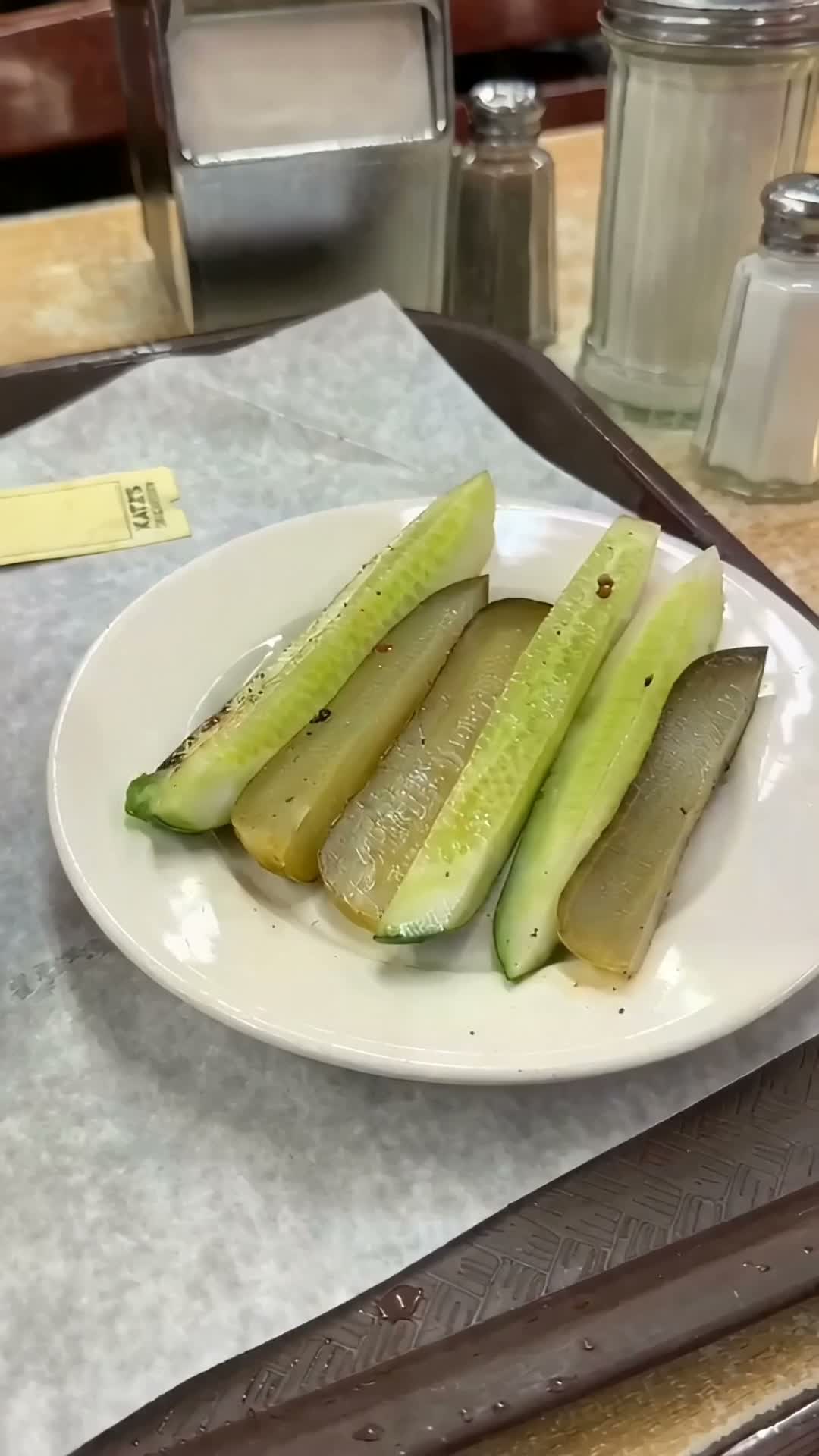
The matzo ball soup is the other dish the camera finds. Hidden Food's video shows a spoon straining under one oversized ball, then cuts to a pastrami sandwich piled high on rye with melted cheese, a dill pickle and a half-sour alongside. The pickles are the right companion for the sandwich: sharp and salty against a great deal of rendered fat.
The rye is the sandwich's weak point, and critics who like the place say so. In a 2022 review of S&P, Pete Wells of The New York Times wrote that the sandwich would not be fantastic until something was done about the rye. He also called pastrami eaten at Katz's "both a meal and a ceremony". The meat makes the argument, the bread merely holds it together, and the ceremony is the ticket and the carver.
What the critics say
The New York Times, in Pete Wells's 2022 review of S&P, said pastrami at Katz's is a meal and a ceremony, while faulting the sandwich's rye bread.